


Ask most people to picture a fairy and they will conjure a small, winged creature in a flower hat. That image is a Victorian invention. For most of British history, fairies were not cute. They were the neighbours you did not upset: powerful, capricious, and dangerously close to the human world. Tracing their story from medieval fear to modern whimsy, and back again, tells us as much about us as it does about them.
The Good Neighbours
In medieval and early modern Britain, fairies were rarely described as tiny. They lived in mounds, called "fairy hills", or in the woods and wild places. People called them the "good neighbours", the "fair folk", or the "gentle people" to avoid naming them directly. To speak of them carelessly was to invite trouble. They could bless a household or curse it, steal a child and leave a changeling, or whisk a midwife away to attend a fairy birth. A brownie might churn your cream and sweep your floor at night, but only if you left a bowl of cream and never thanked him. A boggart would do the opposite, moving from house to house with a family, causing chaos wherever they settled. In the woods, you avoided fairy rings, circles of mushrooms where the fair folk were said to dance. Step inside, and you might be trapped for a year and a day, or return to find your friends grown old.
Reformation and Literary Retreat
The Protestant Reformation of the sixteenth century attacked belief in fairies as popish superstition. Preachers told their congregations that fairies were either delusions or devils. Yet the beliefs did not vanish. They retreated into oral culture, into the stories told by the fire in winter. Meanwhile, poets and playwrights put fairies on the stage. Shakespeare’s A Midsummer Night’s Dream gave us Oberon, Titania and Puck, but it also made fairies small, playful, and aristocratic. Edmund Spenser’s The Faerie Queene turned them into allegory. By the eighteenth century, fairies were fading from serious belief and becoming figures of literature and nursery tales. But in the countryside, people still left offerings at fairy trees and avoided certain wells after dark.
Victorian Whimsy and the Cottingley Fairies
The nineteenth century reinvented fairies. Romantic artists and writers, from Richard Dadd to Arthur Rackham, painted them as delicate, winged, and often child-like. The rise of the Christmas pantomime and the fairy tale collection made them safe for children. Flower fairies, popularised by Cicely Mary Barker in the twentieth century, completed the transformation. Then came the Cottingley Fairies. In 1917, two young cousins, Elsie Wright and Frances Griffiths, took photographs in a Yorkshire garden that appeared to show fairies. Sir Arthur Conan Doyle, creator of Sherlock Holmes and a spiritualist, championed the pictures as genuine. The girls later admitted they had used paper cut-outs, but the images captured the public imagination and fixed the Victorian image of the fairy in the popular mind. It was a long way from the changeling-stealing neighbours of the medieval wood.
The Folklorists and the Uncanny Return
While popular culture made fairies whimsical, folklorists kept collecting older, stranger beliefs. In 1911, W. Y. Evans-Wentz published The Fairy-Faith in Celtic Countries, recording living testimony from Ireland, Scotland, Wales, Cornwall and Brittany. Later, Katharine Briggs assembled a vast archive of British fairy lore, showing how often fairies were feared, respected, and tied to specific places. J. R. R. Tolkien, in his essay On Fairy-Stories, argued that fairies belong to a serious, dangerous enchantment, not to twee decoration. By the late twentieth century, a new generation was visiting fairy mounds and leaving offerings at ancient trees. The Isle of Man still has a Fairy Bridge, where locals greet the fairies when crossing. In Ireland, road plans have been altered to avoid a lone hawthorn, a fairy tree. The old beliefs had not disappeared; they had simply gone quiet.
Meeting the Fair Folk Today
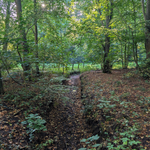
If you walk in British woodland, you are walking through fairy country. The signs are easy to miss: a ring of mushrooms on a grassy clearing, a lone hawthorn or oak standing apart from the others, a foxglove (sometimes called a fairy thimble), or a bluebell wood where fairies were said to be especially active.
Practical folkloric rules survive:
- Do not cut a lone hawthorn or disturb a fairy ring.
- Do not thank a brownie for his help, or he will leave.
- Carry iron or rowan if you feel uneasy in a lonely place.
- Leave a small offering — bread, cream, or a ribbon — at wells and fairy trees.
Some of this is superstition, some is simply good manners towards a place. Either way, it keeps the relationship alive. Modern fairy belief is not just about children’s books. It is there in the fairy doors that appear on city trees, in the offerings of ribbon and bread left at wells, and in the stories people still tell when a path feels suddenly wrong. The fairies have changed shape many times, but they remain what they always were: neighbours. They are not gone. They are just waiting, politely, for us to remember them.





John Doe
14 January, 2022Having no content in post should have adverse..
Chauffina Carr
10 April, 2022We use these tests all time! Killer stuff!
Jim Séchen
16 July, 2022Thanks for all the comments, everyone!