


A Song You Probably Know by Heart
If you grew up anywhere in the North East, you can probably recite the opening of "The Lambton Worm" without thinking: "Whisht! lads, haad yor gobs, an' aa'll tell ye aall an aaful story." The song was written by C. M. Leumane in 1867 for a Tyneside pantomime, but it drew on a legend already centuries old along the River Wear. Strip away the music hall humour and something much older remains — a broken Sabbath, a monstrous serpent, a family curse, and a hero who could not quite win clean.
The Heir, the Sunday Morning, and the Well
The tale begins with young John Lambton, heir to Lambton Castle near Chester-le-Street. On a Sunday morning, rather than sit through the sermon, he took his rod down to the River Wear. He hooked something odd — an eel, a worm, a thing that was neither — small, dark and wriggling. Disgusted, he carried it away and dropped it into an old well near the castle rather than take it home.
That detail is the hinge of the whole story, and it is also a real place: the Worm Well still sits in the Lambton estate, a small stone-lined hollow in the woods. Folk tales cling hardest to landscape, and this one comes with its own coordinates. The well was the creature's cradle; the river would be its hunting ground.
What the Worm Did While He Was Away
John, full of guilt and a taste for adventure, left for the Crusades. In his absence the thing in the well grew. It outgrew the well, then the woods, then all patience. The legend credits it with a remarkable list of offences:
- Coiling nine times around Penshaw Hill, leaving the terraces you can still trace on its slopes.
- Drinking the milk dry from cows across the surrounding farms.
- Taking livestock, and on bad days, children.
- Laying waste stretches of the Wear valley, so that locals left offerings of milk to keep it calm.
Notice what the story is doing. It is not just scaring children. It is explaining why the hill has those ridges, why the riverbank farms struggled, why certain fields were left to scrub. This is folklore working as local geography, and it is the reason the tale outlived the pulpit that inspired it.
The Wise Woman's Bargain
John returned years later, a hardened soldier, to find his inheritance in ruins and his people terrorised. He went for advice to the Witch of Old Eldon — a consultation that is as much a legal contract as a piece of magic. She gave him two instructions.
First, he must fight the worm in the river rather than on dry land, where it could move too freely. Second, he must wear armour studded with long blades, so that every coil of the creature's body cut itself open. Third — and this is the clause that ruins everything — after the killing he must put to death the first living thing that comes to meet him. If he failed, no Lambton would die peacefully in his bed for nine generations.
He agreed. The word given is the trap; the honour of the family is pledged against a monster and against himself in equal measure.
The Fight in the Wear
John had his armour set with razor-sharp spikes and stood waiting in the shallows of the Wear. When the worm came, it wrapped itself around him as it always did, crushing and constricting. This time the blades opened its hide. The current pulled the severed pieces downstream before the creature could knit itself back together — a neat piece of river logic, since this is a beast that regenerates unless the water carries it apart.
So the worm died. But triumph brought its own trap. John sounded his horn, and the first living thing to reach him was not a servant or a dog, but his own father, the old lord, running to embrace him. He could not raise a hand against him. He killed his favourite hound instead — an offering the curse did not accept. For nine generations, the Lambtons were said to die violently, or far from home, or at least never comfortably in their beds.
Reading the Landscape Today
The Lambton Worm belongs to a family of northern serpent tales, kin to the Laidly Worm of Spindlestone Heugh in Northumberland and the Linton Worm over the border. What sets it apart is how tightly it is pinned to the ground. If you want to walk the story, you can.
- Penshaw Hill, crowned by the great grey monument, is the hill the worm coiled around; the old quarry terraces are often read as its rings.
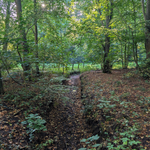
- The River Wear at Fatfield and Washington is the fighting ground, and a good place to note how alder, willow and oak crowd the banks — the kind of tangled water-edge woodland a monster would happily live in.
- The Worm Well lies on the Lambton estate, which is private land with public footpaths nearby, so enjoy it from the rights of way.
Every folk tale carries its own meaning, and this one is about consequence. A boy dodges church for an hour and a well gets a tenant. A man takes a shortcut to honour and his family pays the interest for nine generations. The riverbank is still there, still full of alders, still rising after rain — and the song is still sung in the pubs. That, more than any curse, is how a legend survives.





John Doe
14 January, 2022Having no content in post should have adverse..
Chauffina Carr
10 April, 2022We use these tests all time! Killer stuff!
Jim Séchen
16 July, 2022Thanks for all the comments, everyone!