


A Bird That Carries Meaning
Few birds in Britain carry as much weight as the raven. It is our largest crow, roughly the size of a buzzard, with a heavy bill, shaggy throat feathers and a long, wedge-shaped tail that makes it unmistakable in flight. Its call is a deep, resonant kronk or prruk, a sound that belongs to crags and old woods rather than tidy gardens. That voice, combined with its intelligence and its habit of watching from a distance, has kept the raven at the centre of British folklore for well over a thousand years.
Prophecy, Bran, and the Head Beneath the Hill
In Welsh tradition the raven is bound up with prophecy and with the giant Bendigeidfran, Bran the Blessed, whose name means "raven" or "blessed crow". In the Mabinogion, Bran is mortally wounded in Ireland and asks his companions to cut off his head and carry it to London, where it is buried on the White Hill facing France as a talisman against invasion. The head speaks and comforts for years before it is finally laid to rest. Later legend claims Arthur dug it up, unwilling to be protected by anything but his own strength.
Norse settlers brought their own raven lore. Odin's two ravens, Huginn and Muninn, flew out each day to gather news of the world. In areas of Viking settlement — the Northern Isles, the Hebrides, Cumbria and the Danelaw — this idea of ravens as messengers and witnesses settled comfortably alongside older British beliefs, so that the bird became both a prophet and a guardian.
Guardians of the Tower of London
The most famous ravens in Britain live at the Tower of London, where legend insists the kingdom will fall if they ever leave. The story usually centres on Charles II. The Royal Observatory then stood within the Tower, and the Astronomer Royal is said to have complained that the birds were fouling his instruments. The king ordered them removed, was warned of the prophecy, and decreed instead that at least six ravens should be kept. A Yeoman Warder still looks after them today.
Whatever the historical truth, the tale shows how naturally guardianship attaches to ravens. They are birds that hold a place, return to it, and seem to notice everything that passes. That is exactly the quality that makes them useful in a story about a kingdom under watch.
Ravens in Britain's Place Names
Ravens have left their mark on the map. The Old English hræfn and the Old Norse hrafn both mean raven, and they survive in dozens of names across the country.
- Ravenglass, Cumbria — a coastal village where three rivers meet, with a name shaped by Norse settlers.
- Ravenscar, North Yorkshire — a clifftop village where ravens have long nested on the surrounding crags.
- Ravensbourne — a river in Kent and south-east London, meaning "the raven's stream".
- Ravenstone — parishes in Buckinghamshire and Leicestershire.
- Ravenhill — found from Swansea to Belfast, usually on higher ground.
- Ravenshead, Nottinghamshire — a village on the edge of Sherwood Forest country.
Local legends cluster around these places. In some, ravens are said to guard buried treasure or to linger over old battle sites. In others, a raven on a cottage roof was read as an omen of change. Most of these stories were not invented by writers; they grew from generations of watching the same birds return to the same crags and woods.
Reading Ravens in the Woods
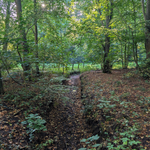
For the nature writer, the raven rewards patience. Look for them in upland oakwoods, in the pinewoods of the Caledonian Forest, and along wooded valleys in Wales and the Lake District. They are wary and usually seen at a distance, so begin with sound.
- Listen for a deep, hollow kronk, quite unlike the harsh caw of a carrion crow.
- Watch for a diamond or wedge-shaped tail, especially when the bird is gliding.
- In spring, look for display flights: rolls, dives and tumbling, often with a sharp ping or knocking call.
- Note where they feed — on carrion, on eggs, on beetles and grubs in pasture — and how they use the wind along a ridge.
Once persecuted heavily, ravens have been returning to wooded areas where they were absent for decades. In parts of Wales and the Borders they now nest in tall conifers as readily as on cliffs. That recovery is itself a story worth recording, and it is best written down close to the place where you saw it.
Keeping the Lore Alive
You do not need a legend to value a raven, but the legends help. They link the Tower, the Welsh hill, the Norse sea-road and the quiet oakwood into a single thread of attention. When you hear that deep call roll across a valley, you are hearing the same sound that shaped the names on the map and the tales told around fires.
Write down the date, the place, the weather and what the bird did. Add your own small entry to a very old record, and the raven will keep doing what it has always done: watching, remembering, and carrying meaning on the wind.




John Doe
14 January, 2022Having no content in post should have adverse..
Chauffina Carr
10 April, 2022We use these tests all time! Killer stuff!
Jim Séchen
16 July, 2022Thanks for all the comments, everyone!