


Why Local Legends Belong in the Workshop
Every parish has a story that will not quite die. A drowned bell in the pond, a highwayman's ghost on the old drovers' road, a yew tree that bleeds when it is cut. These tales are rooted in place, they are free of copyright, and they give a room of writers a shared starting point. That is a gift for any workshop leader. But a local legend is also somebody's heritage — a living thing that belongs to a village, a family, or a community. The exercises below are designed to turn regional tales into short stories, poems and scripts without flattening the voices that keep them alive.
Before You Write: Listening, Variants and Permission
Start with groundwork. Invite a local historian, a storyteller, or a member of the parish council to the first session. Ask who holds the tale and whether there are sensitivities around it. Some legends are safe to play with; others — particularly those tied to a specific family, a recent tragedy, or a Traveller or Romany tradition — need a direct conversation first.
- Collect at least two written or recorded variants of the same legend. Note where they differ.
- Ask what the community would not want changed, invented or published.
- Check local archives, museum records and oral history collections for names and dates.
- Agree a simple credit line with your group: "Based on a legend told in [place], collected by [name]."
This is not bureaucracy. It is craft. Knowing the variants gives you choices; knowing the boundaries gives you freedom.
Exercise One: The Three-Version Short Story
Give writers twenty minutes to list three distinct versions of one legend — for example, the tale of a woodland pool that grants wishes but takes a year of your life. Version A is the romantic telling, Version B the cautionary one, Version C the comic or sceptical one. Then ask each writer to choose the version they find least comfortable and write a 500-word story from the point of view of a marginal figure: the child sent to fetch water, the ferryman, the dog, the tree.
The rule is simple: no narrator who knows the whole truth. Let the legend leak in through detail — a chipped cup, a wet footprint, the price of candles. After twenty-five minutes, read in pairs and ask one question only: which version did you write, and what did you leave out?
Exercise Two: Woodland Poetry and the Boundary List
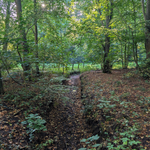
Take the group to a real copse, hedgerow or churchyard if you can, or use photographs and maps if you cannot. Ask for a five-minute sensory map: sound, smell, texture, temperature, one thing moving. Then set one of two poems.
- The voice poem: write in the first person as the yew, the well, the stile or the brook. Six to twelve lines. No rhyming required.
- The boundary list: a list poem of objects left at a threshold — ribbons, coins, a child's shoe, a folded note. Let the list carry the story.
Encourage dialect words if they belong to the place, but ask writers to note them and check them with a local speaker rather than inventing a "folk" voice. Read the poems aloud outdoors if the weather allows. Woodland writing is often best tested by ear.
Exercise Three: The Boundary Scene for Script
Scripts thrive on liminal places: a stile at dusk, a bridge over a brook, the edge of a wood where the footpath forks. Ask writers to draft a two-page scene with three characters. One knows the legend, one half-remembers it, one has never heard it. The scene must turn on a decision made at the boundary — to cross, to wait, to turn back.
Insist on sound in the stage directions: the creak of a gate, the call of a tawny owl, a dog barking two fields away. Then hold a table read with no props. The legend should be present in what characters avoid saying. This exercise works well in a ninety-minute session and gives actors something to bite on.
Giving Back: Credits, Readings and Community
When the work is polished, resist the urge to publish straight away. Share drafts with the people who told you the story. Offer a free reading at the village hall, the library or the woodland trust's annual gathering. Credit your sources on the page. Ask whether the community wants the tale told widely, told locally, or left in the archive.
Avoid the "last keeper of the secret" trope, which turns living neighbours into quaint extras. Let the legend stay a little unresolved. The best writing from local folklore does not explain the mystery; it hands the mystery on, carefully, to the next teller.




John Doe
14 January, 2022Having no content in post should have adverse..
Chauffina Carr
10 April, 2022We use these tests all time! Killer stuff!
Jim Séchen
16 July, 2022Thanks for all the comments, everyone!