


A World in Miniature
There is a moment on a damp October walk when you kneel to tie a bootlace and notice that the log beside you is furred with green. Look closer and that fur becomes a forest: tiny leaves, capsules like miniature urns, and stems that branch with the precision of oak twigs. Mosses and liverworts — bryophytes — are the oldest land plants still with us, and Britain’s damp, oceanic climate makes our woodlands especially rich in them. They have no roots, no flowers, and no woody tissue. They drink rain directly through their leaves and hold water like a sponge. In a British woodland with a stream, a seepage, or a humid hollow, they can cover every surface. The pleasure is not in ticking off rarities but in slowing down enough to see what has been under your boots all along.
Telling Mosses from Liverworts
At first glance, both are green and both grow in damp places. With a hand lens, the differences begin to show. Mosses usually have leaves arranged spirally around a stem, often with a visible midrib or nerve. Their capsules sit on a stalk and have a lid that pops off when ripe. Liverworts are more varied. Leafy liverworts have leaves in two or three rows, often with a row of smaller underleaves beneath the stem. Their leaves are frequently lobed or folded, and their capsules are dark, spherical, and split into four valves on a translucent stalk. Thalloid liverworts, such as the common Marchantia polymorpha, look like flat green ribbons with pores on the surface. A useful rule: if it looks like a tiny fern or feather, check for underleaves. Liverworts often have them; mosses never do.
Where to Look in British Woodland
Bryophytes are not evenly spread. They favour damp, shaded, undisturbed places, and the best woods have a mosaic of microhabitats. Prioritise these:
- Tree bases and roots — especially oak, ash, and willow. Look for Mnium hornum, swan’s-neck thyme moss, forming loose green cushions, and the flat, creeping Metzgeria furcata on smooth bark.
- Rotting logs and stumps — dead wood holds water and supports feathery mats of Thuidium tamariscinum, common tamarisk moss.
- Stream banks and seepages — these are the richest places. Pellia epiphylla spreads as dark green thalli, whilst Sphagnum species build soft, saturated hummocks.
- Soil banks and woodland rides — look for the star-like rosettes of Polytrichum commune, common haircap, on acid banks.
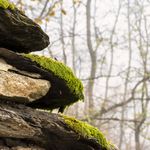
- Rock faces and mortar — shaded sandstone and limestone support distinct communities, often with tiny, cushion-forming mosses.
Acid woods tend to have different species from base-rich woods. In ancient woodland, the bryophyte flora is often richer, because the habitats have been continuous for centuries. Dampness matters more than shade: a dripping gorge in summer can be as good as a shaded wood in winter.
The Hand Lens Habit
A 10x lens is enough to begin; 20x is better for liverworts. Hold the lens close to your eye, then bring the moss towards it until it snaps into focus — do not move your head. Use a white notebook or card behind the specimen to cut out background clutter. Look at one leaf at a time. For mosses, check the shape, the midrib, whether the leaf tip is hair-pointed, and whether the cells are smooth or papillose. For liverworts, search for underleaves, lobules, and the arrangement of leaves. If material is dry, breathe on it or add a single drop of water; many mosses curl up when dry and unfold like ferns when moistened. Keep a small spray bottle in your bag. A headtorch helps in deep shade. Draw what you see; the act of drawing forces you to notice.
Six Bryophytes to Start With
- Common haircap (Polytrichum commune) — tall, stiff, star-like rosettes on acid woodland banks; capsules are square and held high.
- Swan’s-neck thyme moss (Mnium hornum) — pale green cushions on tree bases and banks; leaves have a strong midrib and a toothed edge.
- Common tamarisk moss (Thuidium tamariscinum) — fern-like, feathery, yellow-green mats on damp woodland floors.
- Common liverwort (Marchantia polymorpha) — flat thalloid ribbons with cup-shaped gemmae cups; often on burnt ground or wet paths.
- Overleaf pellia (Pellia epiphylla) — dark green thalloid liverwort on wet soil and stream banks; capsules emerge as black spheres on a pale stalk.
- Flat-leaved scalewort (Frullania dilatata) — small, reddish-brown leafy liverwort on tree bark; leaves have tiny lobules underneath.
Leaving No Trace
Bryophytes are fragile. A patch of moss can take decades to recover from a careless scrape, and a rare liverwort may vanish from a site altogether. Observe ethically: stay on paths where possible, do not scrape bark or rock, and do not collect unless you have permission and a genuine reason. Take photographs or sketches instead. If you must examine a specimen, moisten it with water from your bottle and return it to the same spot. Avoid walking on sphagnum hummocks, which are slow-growing and easily compacted. Keep your boots clean between sites to avoid moving spores and fragments. Many woodlands are Sites of Special Scientific Interest or nature reserves, so check local rules before you visit. The best field guide is a hand lens, a notebook, and the willingness to kneel in the wet. The miniature forest rewards patience, and it is always open.



John Doe
14 January, 2022Having no content in post should have adverse..
Chauffina Carr
10 April, 2022We use these tests all time! Killer stuff!
Jim Séchen
16 July, 2022Thanks for all the comments, everyone!